



India recently had its general elections, which have been widely criticised for being lopsided and unfair. It’s not really the best of times for the country.
There’s severe political polarisation along religious and caste lines.
There’s rampant unemployment — particularly among the youth.
There’s a growing disparity between the rich and the poor — with wealth being concentrated in the hands of a handful.
Unconstitutional laws have almost legalised quid pro quo between govt. and businesses — promoting crony capitalism.
On top of that, the Indian railways is in a dire state with two major accidents in the last couple of days.
Then there’s a country-wide exam paper leak scandal happening.
I closely followed the elections last month — something I’ve never done before. And naturally, I felt very demotivated and sad and also ashamed at the state of the nation.
To say the least, the future looks bleak. It’s not surprising that as many as 5,000 millionaires are leaving India every year. Like everyone, I’m frustrated, angry, and feeling kind of hopeless.
But then I realised something the other day, which kind of gave me a ray of hope.
But before I get onto that, I should mention that I also happened to be following the politics in the US and the UK, and to say the least, none of them look very encouraging either.
If you want a brief synopsis, just watch John Oliver’s Last Week Tonight episodes on the US and the UK elections, and while you’re at it, make sure to watch the episode on India as well. You’ll get the gist.
Alright! With that out of the way, let’s get to the meat of today’s discussion.
Have you noticed that the biggest societal shifts and the most important innovations don’t happen when things are going well and everyone’s happy? Have you observed that they tend to occur only when something very bad is happening? When people are panicked, shocked, or worried — usually when their asses are on fire.
Here are a couple of examples from my home country.
After her independence, India faced severe food shortages and famines in the 1940s and 1950s. This lead to widespread hunger and malnutrition. The result? An agricultural upgrade called The Green Revolution which introduced high-yielding varieties of seeds along with modern agricultural techniques.
India didn’t have a space research program until the Sino-Indian War of 1962, which highlighted the country’s strategic vulnerabilities and the need for technological advancement. The result? The birth of Indian Space Research Organisation or ISRO in 1969, which in 2023 conducted the moon mission Chandrayaan-3 and successfully landed near the south pole of the moon. How awesome is that!
NASA also had a similar origin story. The Soviet Union launched Sputnik 1 — the world’s first artificial satellite — in Oct, 1957. In response, the US government established NASA on July, 1958.
In. Just. Nine. Months.
It’s so easy to bypass all the archaic red tape when your reputation is on the line!
WE’RE GOING TO DIE IF WE DON’T FIGURE THIS OUT.
Take the following innovations.
Radar.
Atomic energy.
The internet.
Microprocessors.
Jets.
Rockets.
Antibiotics.
Helicopters.
GPS.
Digital photography.
Microwave ovens.
Synthetic rubber.
They all either came directly from or were heavily influenced by war.
Why?
Because nothing creates a sense of urgency more than war. The dreaded feeling, “If we don’t figure this out right now we’re all going to die,” can fuel the most incredible innovation in the shortest period of time.
In this aspect, I think the motivation of Silicon Valley coders trying to get you to click on more ads is nothing when compared to the motivation of Manhattan Project physicists.
But, might this not be the case that Oppenheimer and his band of physicists were wildly more capable than Silicon Valley coders? Maybe. Maybe not. There’s no good way to measure this.
But it won’t be totally wrong to say that the same people with the same intelligence have wildly different potential under different circumstances.
I think, as a general rule, the circumstances that tend to produce the biggest innovations are those that cause people to be worried, scared, and eager to move quickly because their future depends on it.
Take digital payment in India for example. Its penetration is arguably much more than any other country in the world. But, would this have been possible without the sudden demonetisation of ₹500 and ₹1,000 banknotes in 2016?
I think the answer would be NO — at least it would not have been possible to the extent that it occurred. The demonetisation forced people to find alternate ways to transfer money. Today, every street vendor in India accepts payment digitally. I for one don’t remember when was the last time I’d used an ATM.
Similarly, you could never push through something like the economic liberalisation of India in 1991 — when the govt. opened up the economy to global markets and reduced its control over business activities — without an economy so wrecked that people were desperate to try anything to fix it.
NOT TODAY. NOT TOMORROW. BUT SOON.
In businesses, managers rarely ask their employees to go try something wild, or to blow up the playbook, or, to forget about the rules of the game when the economy is booming and the outlook is bright.
Such stuff is said only when it’s the only thing that is left to be said.
In 1999, Marvel barely survived bankruptcy. Even though they had 4700 comic-book characters, Hollywood was mostly interested in Spider-Man and the X-Men — which were already licensed to Sony Pictures and Fox at dirt cheap rates.
The challenge for Marvel president Kevin Feige was to find a way to create value out of a bunch of not-so-valuable characters — such as Iron Man and Captain America.
This led to the creation of the Marvel Cinematic Universe, where a large group of characters could inhabit the same “shared universe.”
This had never been tried before. This most likely would have never even been tried at all if Marvel didn’t have its ass on fire.
We learn so little from peace. Big, fast changes happen only when they’re forced by necessity.
COVID-19 started off as mass panic and poor management, but ended with an astounding development and production of new vaccines at a pace that has never been seen before.
What I mean to say is this: even if the present looks dire, even if it looks far worse than the immediate past, it doesn’t mean that the future has to fare the same fate as well.
Great things and unprecedented changes are born out of dire situations. That’s just how it works.
At least I think so.
Stress, pain, discomfort, shock, disgust — for all their tragic downsides, it’s also when the magic happens. Therefore, I’m not so much worried about India or the rest of the world for that matter.
I do feel hopeless sometimes, but I’m also kind of optimistic. I believe we’d get out of this mess of a situation stronger and better.
Not today. Not tomorrow. But soon. Just when our asses are on fire.
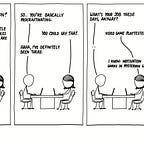
In that aspect — and on a much lighter note — I believe procrastination is a feature, and not a bug. Procrastination is nothing but the act of turning a nice, sweet, peaceful situation into a warzone — where deadlines are looming, and unless you do something very big very fast, you’re gonna be dead.


